
This is part of our series of guides for parents of deaf children. You can also read: Deaf children at school (ages 5 to 16) | Deaf young people: transition to adulthood (16 to 25) | Back to the main deaf children page.
Your child may be the first person with hearing loss – whether through the newborn screening programme or later. Whatever the circumstances, experiencing it with your child can be a daunting and even frightening experience, but it doesn’t have to be.
The most important point to note is that hearing loss is not life-limiting. There are many adults who have some level of hearing loss or deafness living happy, fulfilling lives. They are working, enjoying friendships and relationships the same as individuals with no hearing loss or deafness. With the right support, deaf children develop language, make friendships, and go on to lead full and happy lives.
How is hearing loss identified?
Most hearing loss in babies is identified through the Newborn Hearing Screening Programme (NHSP), which is offered to all babies in England shortly after birth. If your baby does not pass the initial screen, you will be referred for further tests. A diagnosis can be confirmed within the first few weeks of life.
Not all hearing loss identified through screening is permanent – some babies have temporary hearing loss caused by glue ear (a build-up of fluid in the middle ear), which often resolves on its own. Your audiology team will help you understand whether your child’s hearing loss is permanent or temporary and what this means for their development.
Below is an image of the ‘speech banana’. Deafness affects the ability to hear certain speech sounds. the sounds are highlighted by the speech banana. Some of these sounds are also difficult to pick up from lip reading such as ‘h’ and ‘k’.
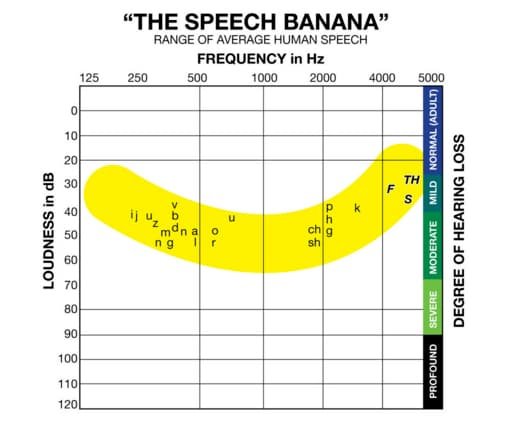
The image is a mock audiogram that shows the sounds that are most difficult to pick up when you have hearing loss. The image is attributed to Diego SLP.
What happens next — audiology and hearing aids
Once the level of hearing loss has been confirmed, the audiology team will advise you on whether hearing aids or cochlear implants are appropriate for your child. The team will also refer you to other specialists as needed, which may include:
- A speech and language therapist, who will support your child’s communication development
- A Teacher of the Deaf (ToD) — a specialist teacher who works with deaf children and their families from a very early age. They visit your home, advise on communication strategies, work with your child’s nursery, and help you understand your child’s rights and needs. If you have not been offered this service, ask your audiology team or contact MK SENDIAS.
Your child will need time to adjust to hearing aids or implants. They will need to understand and be guided by the sound vibrations they experience. In the early stages, a good way to build meaning around sound is to also use a visual language (BSL) alongside spoken language.
IN MILTON KEYNES
Milton Keynes University Hospital provides audiology services for children. The team performs hearing tests, advises on hearing aids and other interventions, and coordinates referrals to other professionals.
Children’s Audiology — Milton Keynes University Hospital
Communication choices
One of the first big questions hearing parents face is how to communicate with their deaf child. There is no single right answer — what matters most is giving your child access to language as early as possible.
There are three main approaches:
British Sign Language (BSL)
BSL is a complete, visual language with its own grammar and syntax. It is recognised as an official language in the UK. For children who are profoundly deaf, BSL can provide full and natural language access from the very beginning. Some families choose BSL as their primary language at home.
Oral / auditory-verbal approach
This approach focuses on developing listening and spoken language, usually with the support of hearing aids or cochlear implants. It works well for children with some residual hearing and is the approach used in most mainstream schools.
Total Communication
Total Communication uses a combination of signs, speech, lip-reading and any residual hearing to support communication. Signed Supported English (SSE) is widely used in mainstream schools and gives children access to multiple channels of communication at once.
Myth Buster: Will sign language delay my baby’s ability to speak? No — this is a well-established myth with no basis in evidence. Research consistently shows that children who learn sign language alongside speech develop larger vocabularies and stronger language skills, not smaller ones. The key is giving your child access to language early — in whatever form works best for them.
Early years support and resources
Learning sign language as a family
Most deaf children are born to hearing parents who have no prior knowledge of sign language. Learning BSL together as a family is one of the most valuable things you can do — for your child’s language development and for your connection with them.
- NDCS run a free basic sign language course for parents of children aged 0–5.
- Tiny Talk run baby signing classes using BSL that are suitable from birth.
- SignBSL.com is a free online BSL dictionary with video demonstrations of thousands of signs.
NDCS — resources for parents of deaf children. They have a range of YouTube clips teaching basic BSL signs you can use at home.
Tiny Talk baby signing classes
SignBSL.com — free BSL dictionary
Local groups and activities in Milton Keynes
Hedgerows Family Centre (Netherfield) offers family support and activities for children aged 0–5 and their families.
Address: Langland Road, Netherfield, Milton Keynes MK6 4NP — Tel: 01908 239000
Parents and Carers Alliance (PACA) that provide information and support to parents and carers of children with special needs. Membership is free and they provide a number of events to bring children and families together.
MK Deaf Zone also runs community activities. See our socials page for upcoming events.
MK Deaf Zone community activities
TV and media for young deaf children
BSL Zone has a dedicated children’s section featuring deaf children taking part in a range of activities.
The BBC programme Magic Hands is presented by deaf presenters and is suitable for young children.
- The British Deaf Association (BDA) also run sign language training for parents within the home.
- There are a number of pre-school companies such as The Signing Company and Tiny Talk for parents and toddlers to learn signs to nursery rhymes and stories.
- Cbeebies has an information page for parents that explains how signing can help your child communicate.
- There are also a number of baby signing books.
- ITV has an app and Facebook page dedicated to signed stories.
Financial support
Children under 16 with a hearing impairment may be entitled to Disability Living Allowance (DLA). This does not depend on the severity of the hearing loss — it depends on the level of care and supervision your child needs.
Family Fund provides grants for families raising disabled or seriously ill children aged 0–17 on a low income — including for equipment, computers, tablets, clothing, bedding and family breaks.
Birkdale Trust provides grants for children up to age 25 with a hearing impairment, covering BSL courses, specialist equipment and professional advice.
Mental health and wellbeing
It is worth knowing that the parents of newly diagnosed deaf children can experience grief, guilt and anxiety — these are completely normal responses. Connecting with other families on the same journey can make an enormous difference. The NDCS runs local family groups, and MK Deaf Zone can connect you with the local deaf community.
Ready to read about school-age support? Our next guide covers ages 5 to 16 — including EHC plans, school choices, and communication support in the classroom.
Deaf children at school: ages 5 to 16
Back to the main deaf children page
Additional resources (about online safety):
If you have a child with an autistic spectrum disorder (ASD) you can find a useful online safety guide at Wizcase.
Other useful websites about website safety include https://www.internetmatters.org/