
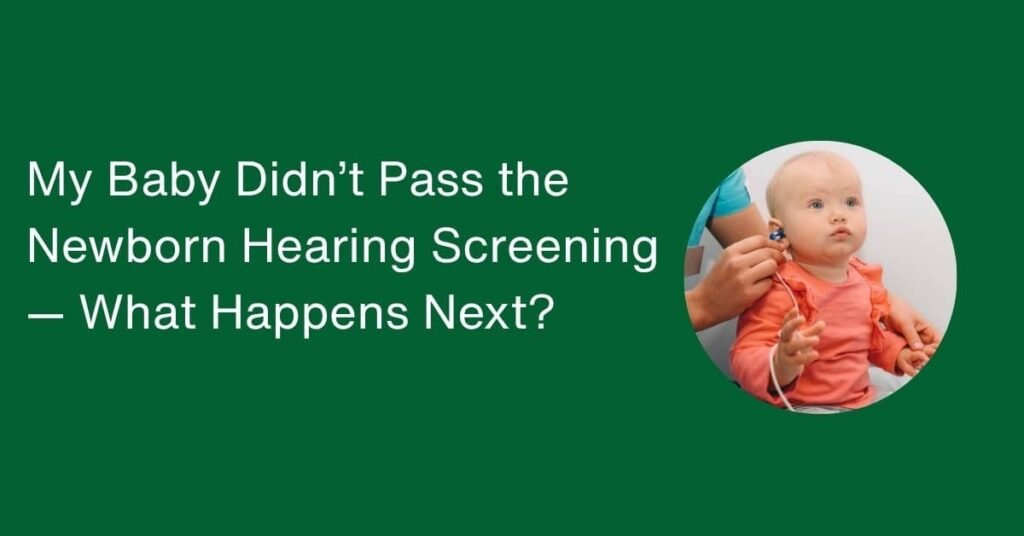
| A referral after the newborn hearing screening does not mean your baby is deaf. Most babies who are referred go on to have normal hearing. This guide explains exactly what happens next, step by step. |
Getting a referral after your baby’s newborn hearing screening can feel frightening. You may have left the hospital or midwife appointment with a lot of questions and not many answers. That is completely understandable — and you’re not alone.
The most important thing to know straight away is this: a referral is not a diagnosis. It means your baby needs a further check. Most babies who are referred at this stage are found to have normal hearing.
This guide walks you through what the screening involves, what a referral means, what happens at the follow-up appointments, and what support is available in the East of England if your child is found to have a hearing loss.
What is the newborn hearing screening?
The Newborn Hearing Screening Programme (NHSP) is a free NHS service offered to all babies born in England, usually within the first few weeks of life. It is one of the most routine parts of newborn care — around 800 babies are identified with permanent hearing loss through the programme every year in the UK.
The screening uses a quick, painless test called an Automated Otoacoustic Emissions test (AOAE). A small soft-tipped earpiece is placed gently in your baby’s ear. It sends quiet clicking sounds into the ear and measures whether the inner ear responds. The test takes only a few minutes and your baby does not need to do anything — it works best when they are calm or asleep.
If the first screen does not give a clear result, your baby will be offered a second screening test, sometimes on the same day or shortly after. If that also does not give a clear result, you will be referred for a full audiology assessment.
Why might a baby not pass the screening?
There are several reasons a baby might not get a clear result, and most of them are not related to permanent hearing loss:
- Fluid or vernix (the waxy coating present at birth) in the ear canal — this is very common in newborns and usually clears within days
- A unsettled or restless baby during the test — movement and crying create background noise that can interfere with the result
- Glue ear (fluid in the middle ear) — a very common and usually temporary condition that often resolves on its own
- Temporary hearing loss due to a minor ear infection
- Permanent hearing loss — this is less common, but it is the reason the screening exists
A follow-up audiology appointment will establish which of these applies to your baby.
What happens at the audiology appointment?
| 1 | Referral to audiology Your baby is referred to the audiology department at your local hospital. In Milton Keynes this is the Children’s Audiology Service at Milton Keynes University Hospital. Across the East of England, this will be at your nearest NHS trust. The appointment is usually within a few weeks. |
| 2 | Diagnostic hearing assessment The audiologist will carry out a more detailed hearing test. For very young babies this is usually an Automated Auditory Brainstem Response (AABR) test, which measures how the hearing nerve responds to sound. It is safe, painless and does not require your baby to respond. Older babies may have different types of assessment. |
| 3 | Results and explanation The audiologist will explain the results clearly and what they mean for your baby. If hearing loss is confirmed, they will explain the type, degree and whether it is likely to be permanent or temporary. |
| 4 | Next steps agreed If hearing loss is confirmed, the team will discuss the next steps with you — which may include hearing aids, further tests, or a referral to other specialists such as a speech and language therapist or a Teacher of the Deaf. |
What if my baby is found to have a hearing loss?
If your baby is diagnosed with a hearing loss, you will be supported by a team of professionals. Depending on the type and degree of hearing loss, this may include:
- An audiologist — who will fit and manage hearing aids or advise on cochlear implants
- A Teacher of the Deaf (ToD) — a specialist teacher who works with deaf babies and their families from a very early age, often visiting your home
- A speech and language therapist — who will monitor and support your baby’s communication development
- A paediatrician — who may investigate whether the hearing loss is associated with any other condition
Hearing aids can be fitted from a very young age — sometimes within weeks of diagnosis. The earlier your baby has access to sound (or to sign language, if that is the right choice for your family), the better their language development will be.
| Early intervention makes a significant difference. Research consistently shows that children identified with hearing loss early and given appropriate support develop language skills on a par with their hearing peers. |
Could my baby’s hearing loss be temporary?
Yes — and this is quite common. Glue ear (otitis media with effusion) is the most frequent cause of temporary hearing loss in young children. It occurs when fluid builds up in the middle ear, affecting how sound travels through it.
Glue ear often resolves on its own without any treatment, particularly in children under two. Your audiology team will monitor your baby’s hearing over time. If glue ear persists and is affecting your child’s development, treatment options including grommets (tiny ventilation tubes inserted into the eardrum) may be discussed.
Communication choices — what are your options?
If your baby has a permanent hearing loss, one of the first questions you will face is how to communicate with them. There is no single right answer — what matters most is giving your baby access to language as early as possible, in whatever form is right for your family.
The three main approaches are:
- British Sign Language (BSL) — a complete visual language, ideal for babies with profound or severe hearing loss, or for families who want a fully accessible language from birth
- Oral / auditory-verbal — focusing on developing listening and spoken language, usually alongside hearing aids or cochlear implants
- Total Communication — using a combination of sign, speech, lip-reading and residual hearing together
Our full guide to communication choices is in the birth to 5 section of our deaf children support pages.
→ Communication choices for deaf children (birth to 5)
Frequently asked questions
| Will my baby need to be sedated for the audiology tests? |
No. The diagnostic tests used for babies are designed to work without any response from your baby. The AABR test simply measures electrical responses in the hearing nerve — your baby can be awake, feeding or asleep. No sedation is needed.
| How long will we wait for an audiology appointment? |
Referrals from the newborn hearing screening are treated as a priority. Most families are seen within four to eight weeks, though this varies by area. If you are concerned about the wait time, contact your midwife or health visitor who can chase the referral.
| My baby passed the screening but I am still worried about their hearing. What should I do? |
Trust your instincts. The newborn screening does not detect all types of hearing loss — some forms of hearing loss develop after birth, and some are not picked up at the screening stage. If you have concerns at any point, speak to your health visitor or GP and ask for a referral to audiology.
| Is hearing loss hereditary? |
It can be. Around 50% of childhood deafness has a genetic cause. However, 90% of deaf children are born to hearing parents — so most families have no prior history of deafness. A referral to a genetics team may be offered if permanent hearing loss is confirmed, to help understand the cause.
| I feel overwhelmed. Is this normal? |
Completely. Many parents describe the period between the screening referral and the audiology results as one of the most anxious of their lives. Connecting with other families — through the NDCS, local groups, or MK Deaf Zone — can make an enormous difference. You do not have to go through this alone.
Local contacts in the East of England
If your baby is referred after the newborn hearing screening, your audiology appointment will be at your nearest NHS trust. Key contacts in the region:
| Area | Audiology service |
| Milton Keynes | Children’s Audiology — Milton Keynes University Hospital. Tel: 01908 996 337 |
| Bedford / Luton | Bedfordshire Hospitals NHS Foundation Trust — Children’s Audiology |
| Hertfordshire | East and North Hertfordshire NHS Trust or West Hertfordshire NHS Trust depending on your location |
| Cambridgeshire | Cambridge University Hospitals NHS Foundation Trust — Audiology Department |
| Norfolk | Norfolk and Norwich University Hospitals NHS Foundation Trust |
| Suffolk | East Suffolk and North Essex NHS Foundation Trust |
You can also ask your midwife or health visitor to help you chase or locate your nearest audiology service.
National support
The National Deaf Children’s Society (NDCS) is the leading charity for families of deaf children. Their freephone helpline offers free, independent advice on anything related to childhood hearing loss — including what to expect at audiology appointments, communication choices, and what support your child is entitled to.
Helpline: 0808 800 8880 (free, Monday–Thursday 9am–5pm, Friday 9am–12:30pm)
NDCS — National Deaf Children’s Society
The NDCS also has a text phone service and can be contacted via SignVideo for BSL users.
MK Deaf Zone supports the deaf community in and around Milton Keynes and across the East of England. If you would like to connect with other local families, see our community and socials page.
MK Deaf Zone community activities
What to read next
Once you have your audiology results, the following guides will help you with the next steps:
→ Deaf children: birth to 5 — early diagnosis and the first years
→ EHCP for deaf children — a parent’s guide (coming soon)
→ Back to the main deaf children support page
| Recommended resources | |
| BSL Baby Sign — Let’s Sign* | The Let’s Sign book offers British Sign Language vocabulary with video clips by Remark! It’s ideal for parents who want to start using BSL with a young baby before speech develops |
| You and Your Deaf Child — John Adams* | A practical handbook for hearing parents of deaf children. Covers diagnosis, communication choices, education and family life. Recommended by the NDCS. |
| Let’s Sign Early Years, BSL Building Blocks Child & Carer Guide | The book is specially written and illustrated for early childhood communication and language development through BSL signs – for the home, nursery, playgroup or school. |
| Raising and Educating a Deaf Child: A Comprehensive Guide to the Choices, Controversies, and Decisions – Faced by Parents and Educators – Marc Marsharck | The book discusses the choices parents and educators make that direct a child’s future. The author says that Deaf children are not hearing children who can’t hear… Understanding the unique strengths and needs of deaf children is the key. |
| NDCS — recommended books for families | The NDCS website has a curated reading list for parents at every stage of the journey. Visit ndcs.org.uk for their full recommendations. |
Missing resources?
Are there resources you’d like to see here? Get in touch and we will add relevant resources for families with deaf and hard of hearing children.