
Dentists are the least capable when communicating with deaf or hard of hearing patients. This is partly due to to perception that communicating with deaf or hard of hearing patients can be challenging but adjustments for deaf and hard of hearing patients in dental practices are easier than you think.
Here are some practical tips to help make communicating easier and appointments accessible, from booking through to aftercare.
General Deaf Awareness Tips
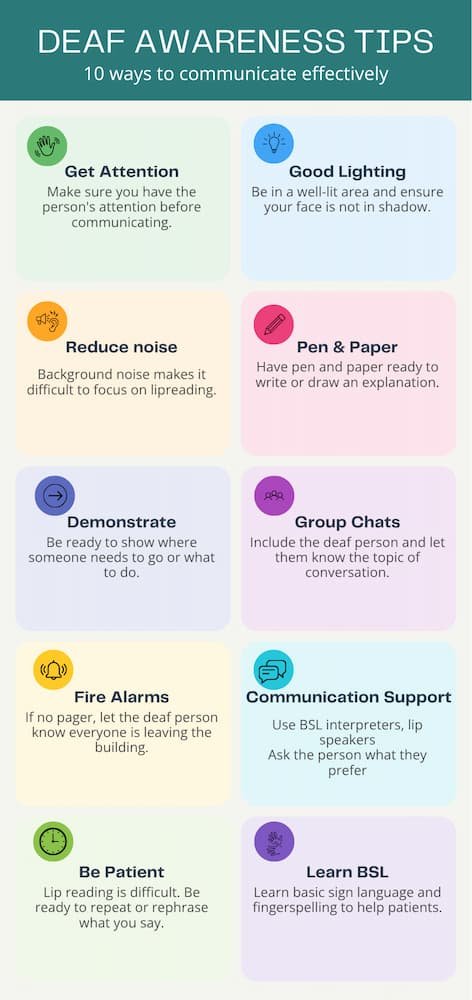
- Attention – make sure you have the person’s attention before communicating
- Lighting: Make sure you are in a well-lit area and your face is not in shadow. Take your facemask off before speaking so the deaf patient can lip read you.
- Noise: reduce background noise e.g. turn the radio or tv off, avoid opening packets or checking equipment while speaking to the patient.
- pen and paper: Have pen and paper ready to write/draw an explanation.
- Demonstrate: Be ready to demonstrate where someone needs to go or what they need to do.
- Group chats: If talking in a group, remember to include the deaf person and let them know the topic of conversation
- Fire alarms: let the deaf person know that everyone is leaving the building
- Communication support: Ask the person what their communication preference is. Know how to book BSL interpreters from your NHS approved agency.
- Be patient: lip reading is difficult. Be ready to repeat or rephrase what you are saying.
- Learn BSL: learning basic sign language and fingerspelling can support communication. Useful signs for dentists are listed at the bottom of this page.
Adjustments before the Appointment
- Are you still stuck in the 20th century and only providing a phone number for contact? Patients of all ages have a range of communication preferences. Ask about communication needs at the point of booking
- Offer email, text or online booking alongside phone.
- If a BSL interpreter is needed, book one in advance through the approved nhs interpreting provider. Costs are covered by the Integrated Care Board. Don’t use a family member or friends, only qualified language service professionals.
- Allow extra time in the appointment slot where communication support is needed
Adjustments in the waiting room
- Use a visual display, or make eye contact and gesture rather calling names aloud
- Check the hearing loop is actually switched on, not just installed
Adjustments during treatment
- Explain what you’re about to do before the mask goes on, where clinically possible
- Face the patient and keep your hands away from your mouth
- Don’t talk with your back turned while reaching for equipment
- Write things down rather than relying on speech alone
- Check understanding by asking the patient to repeat to repeat back what they need to do, rather asking “does that make sense?”
Adjustments after treatment
give aftercare instructions in writing, not just verbally, since these often cover what to avoid over the next 24 to 48 hours
follow up in an accessible format if needed, rather a phone call.
Equipment:
- Clear or visor-style masks, where clinically appropriate, so lip reading can continue during treatment
- A working hearing loop at reception