
Adjustments for deaf and hard of hearing employees are easier than you think. Here are some great tips to help create a positive work environment for you and deaf or hard of hearing employees at meetings or training.
General Deaf Awareness tips:
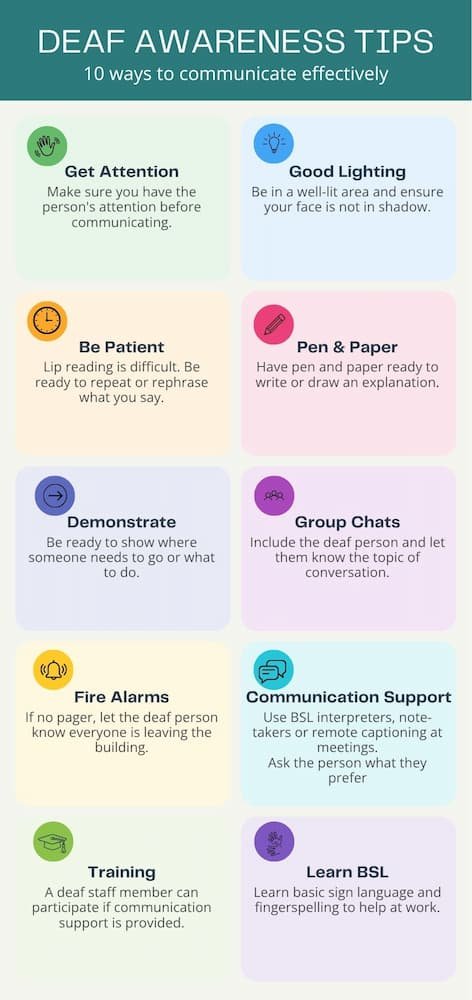
- Attention – make sure you have the person’s attention before communicating
- Make sure you are in a well-lit area and your face is not in shadow
- Be patient – lip reading is difficult. Be ready to repeat or rephrase what you are saying
- Have pen and paper ready to write/draw an explanation
- Be ready to demonstrate where someone needs to go or what they need to do
- If talking in a group, remember to include the deaf person and let them know the topic of conversation
- Fire alarms – if the deaf person does not have an alerting device, let the deaf person know that everyone is leaving the building
- Communication support – there are a number of ways to ensure deaf staff are included at meetings e.g. using BSL interpreters, note-takers or remote captioning. Ask the person what their communication preference is
- Training – a deaf staff member is able to participate in training if communication support is provided
- If a person uses BSL, learning basic sign language and fingerspelling to help facilitate communication at work. Useful signs for the office are listed at the bottom of this page.
Adjustments in an Office Environment
There are a number of adjustments you can make to an office environment. We have outlined suggested adjustments for before, during and after a meeting.
Before the Meeting
- Consider the layout of the room (i.e. circular seating) in order to provide good communication
- Ideally, use a room where a hearing loop has been fitted
- Hold meetings in a quiet, well-lit room
- If the deaf or hard-of-hearing employee needs an interpreter, make sure you organise this before the meeting.
- Let deaf employees determine the best seating arrangement to see the speaker and interpreter
- Assign a person to inform deaf or hard-of-hearing employees of important announcements
During the Meeting
- Point to the person who is speaking
- Watch for signals that deaf or hard-of-hearing employees wish to contribute
- Ensure that one person speaks at a time
- Do not pace while giving a presentation
- Speak clearly and slowly
- Do not talk with your back to the audience while writing on a whiteboard
- Keep jargon to a minimum
After the Meeting
- Have minutes or notes taken for future reference
- Review critical issues introduced in a meeting to ensure understanding
Adjustments for Training
- Use hands-on demonstrations to assist in training
- Allow extra time for communication when training
- Provide an outline of the training session
- Assign a mentor to work directly with deaf or hard-of-hearing employees during the training period
Equipment
- Incorporate visual aids, demonstrations, flip charts, written agendas, and handouts in presentations
- Use captioning on video clips
Adjustments In Case of Emergency
- Use a buddy system to alert deaf or hard-of-hearing employees to emergency situations
- Install flashing lights to work in conjunction with auditory alarms
- Review safety procedures, including exits and alarms. Deaf employees need a Personal Emergency Exit Plan (P.E.E.P)
- Use texting to contact deaf or hard-of-hearing employees in the event of an emergency
- Notify security if deaf or hard-of-hearing employees are alone in work areas
Work-related BSL Signs
A glossary of useful work-related signs are listed below:
Good morning, good afternoon
Last week, yesterday,
today, tomorrow
Interpreter, communication support
When,
where, what, who
Me, you/him/her,
Desk, Laptop
book, paper,
file, computer.
Scanner, copier,
, print,Email
Source: National Technical Institute for the Deaf National Center on Employment / MK Deaf Zone
Helping newly diagnosed employees
Did you know it takes up to 10 years for men to check their hearing? For women it takes around 2 years to get a test. There are simple ways to check your hearing. For example, you can do a quick hearing test online.
Our guide (above) helps you make the reasonable adjustments for staff at whatever stage of their hearing loss/deafness journey.
There are other free guides available on this site that could be useful to you. For example, we have a guide about Access to Work – the government funding that pays for equipment or communication support for employees.
if you have any specific adjustment questions, please contact us for further guidance and support.